👉 Enter Cost Price & Selling Price → Click Calculate
Enter values above and calculate to see step-by-step solutions with your numbers.
⬆️ Enter CP & SP above and click Calculate to see live solutions here.
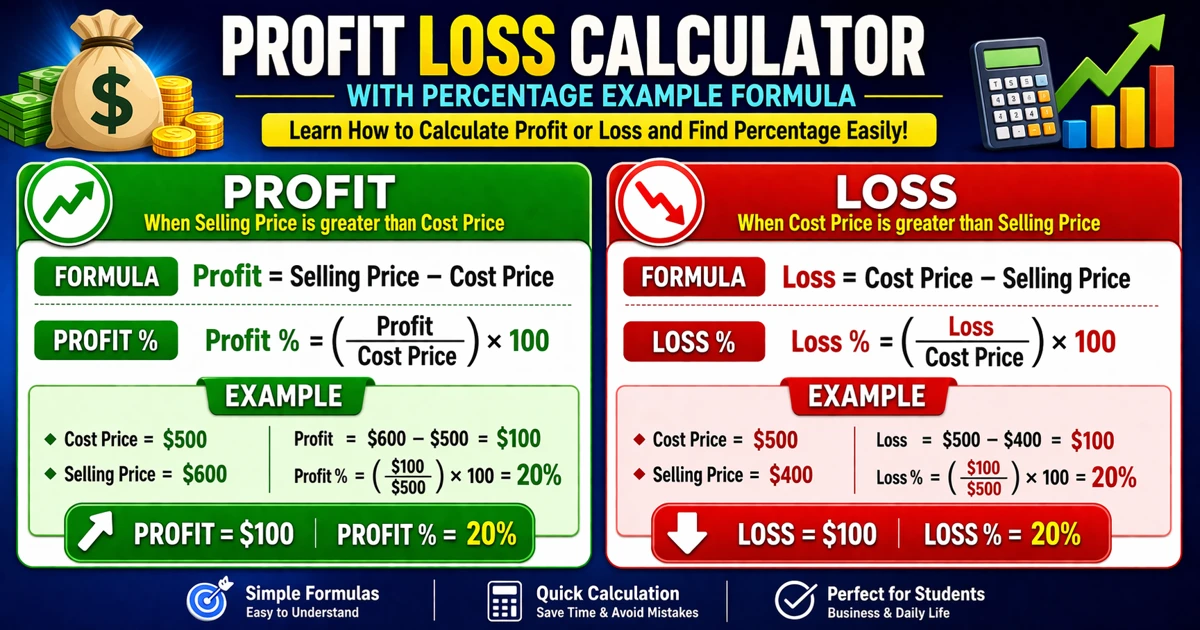
What is Profit and Loss Calculator?
A profit and loss calculator is a tool used to calculate profit, loss, and percentage based on cost price and selling price. It helps in solving questions quickly without manual calculations.
Last Updated: March 2026
About This Calculator
This tool is designed for students, traders, and competitive exam preparation (SSC, IBPS, CAT, UPSC CSAT, RRB). It shows instant results with step-by-step solutions using 5 different methods — from basic formula to ratio speed method used in exams.
🔵 Core Formulas
📊 Percentage Formulas
💡 Find SP from CP & %
🔍 Find CP from SP & %
🏷️ Discount & Marked Price
🛒 What is Cost Price (CP)?
Cost Price (CP) is the price at which a trader purchases an item. It includes the purchase price plus any additional expenses like transportation, repairs, or taxes paid before selling. If these extra costs are mentioned in a problem, always add them to CP.
💰 What is Selling Price (SP)?
Selling Price (SP) is the price at which an item is sold to the buyer. If SP > CP, the seller makes a profit. If SP < CP, the seller incurs a loss.
📈 What is Profit?
Profit occurs when you sell something for more than what you paid for it. The difference is your gain.
📉 What is Loss?
Loss happens when you sell something for less than what you paid. Nobody wants this — but it's important to calculate when it happens!
🏷️ What is Marked Price (MP)?
Marked Price is the price written on the tag of a product — also called the "list price" or "MRP". It's the price before any discount. The selling price is what you actually pay after discount.
| Term | Symbol | What it means | Calculated on |
|---|---|---|---|
| Cost Price | CP | Amount paid to buy | — |
| Selling Price | SP | Amount received on sale | — |
| Marked Price | MP | Price on tag / label | — |
| Profit | P | SP − CP (when SP > CP) | — |
| Loss | L | CP − SP (when CP > SP) | — |
| Profit% | P% | (Profit / CP) × 100 | Always on CP ✅ |
| Loss% | L% | (Loss / CP) × 100 | Always on CP ✅ |
| Discount% | D% | (Discount / MP) × 100 | Always on MP ✅ |
Click any example card to auto-fill the calculator above ↑
📝 Fully Worked: Exam-Style Problem
→ SP > CP, so it's a Profit! ✅
Practice questions for SSC, IBPS, CAT, RRB, UPSC CSAT exams. Click any question to use the calculator above.
🔵 Basic Level Questions
Q1. CP = 500, SP = 650. Find Profit and Profit%.
Answer: Profit = 150, Profit% = 30%
Q2. CP = 800, SP = 680. Find Loss and Loss%.
Answer: Loss = 120, Loss% = 15%
Q3. A shopkeeper buys a pen for ₹40 and sells it for ₹52. Find Profit%.
Answer: Profit = ₹12, Profit% = 30%
Q4. CP = 1200, SP = 960. Find Loss%.
Answer: Loss = 240, Loss% = 20%
Q5. If CP = 350 and Profit% = 20%, find the Selling Price.
Answer: SP = 350 × 120/100 = 420
🟠 Intermediate Level Questions
Q6. A trader buys goods for ₹2000, spends ₹200 on transport, and sells for ₹2500. Find Profit%.
Answer: Actual CP = 2200, Profit = 300, Profit% = 13.64%
Q7. SP = 480 and Loss% = 20%. Find CP.
Answer: CP = 480 × 100/80 = 600
Q8. A book is marked at ₹500 and sold at 10% discount. What is the SP?
Answer: SP = 500 × 90/100 = 450
Q9. An article is sold at 25% profit. If CP = ₹640, find SP.
Answer: SP = 640 × 125/100 = 800
Q10. CP = 750, Overhead = 50, SP = 900. Find Profit%.
Answer: Actual CP = 800, Profit = 100, Profit% = 12.5%
🔴 Exam Tricky Questions
Q11. Two articles are sold at ₹990 each — one at 10% profit, other at 10% loss. Find net profit or loss.
Answer: Net Loss% = 10²/100 = 1%. There is always a net LOSS in such cases.
Q12. A shopkeeper marks price 40% above CP and gives 20% discount. Find Profit%.
Answer: Let CP=100, MP=140, SP=140×80/100=112. Profit% = 12%
Q13 (MCQ). CP:SP = 4:5. What is Profit%?
(a) 20% (b) 25% (c) 30% (d) 15%
Answer: (b) 25% → Profit% = (5-4)/4 × 100 = 25%
Q14 (MCQ). SP = 756, Profit% = 8%. Find CP.
(a) 660 (b) 700 (c) 720 (d) 680
Answer: (b) 700 → CP = 756 × 100/108 = 700
Q15 (MCQ). A man buys 10 items for ₹100 and sells 8 items for ₹100. Find Profit%.
(a) 20% (b) 25% (c) 15% (d) 18%
Answer: (b) 25% → CP per item = ₹10, SP per item = ₹12.5, Profit% = 25%
If SP:CP = a:b → Profit% = (a−b)/b × 100
If two articles are sold at the same SP with equal profit% and loss%, there is always a net loss.
E.g. Both sold at 20% P and 20% L → Net Loss = (20²)/100 = 4%
Merchant claims to sell at CP but uses false weight of x grams instead of 1000g.
Two discounts of a% and b% → Effective discount = a + b − (ab/100)
E.g. 20% + 10% = 20 + 10 − 2 = 28% effective discount (not 30%!)
In a shop, you often see "20% off on MRP". This is where Marked Price and Discount come in. Let's understand with a clear example.
📱 When You Buy & Sell a Phone
You buy a smartphone for 15,000. After 1 year, you sell it for 10,000. This is a Loss of 5,000. Loss% = (5000/15000) × 100 = 33.33%. Electronics always depreciate — understanding P&L helps you make smart decisions.
🏪 How Shopkeepers Price Products
A wholesale merchant sells shirts at 200. A retailer buys 50 shirts, paying 10,000. He pays 500 for delivery. His actual CP = 10,500 ÷ 50 = 210 per shirt. He marks them at 350 and gives 10% discount. SP = 315. Profit per shirt = 315 − 210 = 105. Profit% = 50%!
📈 Stock Market Basics
Shares work exactly like P&L. You buy 100 shares at 50 each (CP = 5,000). Price rises to 65, you sell (SP = 6,500). Profit = 1,500. Profit% = (1500/5000) × 100 = 30%. Understanding P&L is your first step to understanding investments.
🏘️ Real Estate
A flat bought for 30 lakhs in 2015 and sold for 48 lakhs in 2023. Profit = 18 lakhs. Profit% = 60% over 8 years. That's roughly 7.5% per year — not bad, but only if you knew how to calculate it!
What is the CP:SP Ratio Method?
In Profit & Loss problems, CP : SP ratio is the fastest way to find profit% or loss% without using formulas. If CP = 4 parts and SP = 5 parts, then Profit% = 1/4 × 100 = 25%. Once you memorise this table, exam problems become 5-second mental math.
📈 Profit % → CP : SP Ratio Table
| Profit % | CP : SP | Fraction | Quick Trick |
|---|---|---|---|
| 100% | 1 : 2 | 1/1 | SP = double CP |
| 50% | 2 : 3 | 1/2 | SP = 1.5× CP |
| 33⅓% | 3 : 4 | 1/3 | SP = CP + CP/3 |
| 25% | 4 : 5 | 1/4 | SP = 1.25× CP |
| 20% | 5 : 6 | 1/5 | SP = CP + CP/5 |
| 16⅔% | 6 : 7 | 1/6 | SP = CP + CP/6 |
| 14²⁄₇% | 7 : 8 | 1/7 | SP = CP + CP/7 |
| 12½% | 8 : 9 | 1/8 | SP = 1.125× CP |
| 11⅑% | 9 : 10 | 1/9 | SP = CP + CP/9 |
| 10% | 10 : 11 | 1/10 | SP = 1.1× CP |
| 91⁄11% | 11 : 12 | 1/11 | SP = CP + CP/11 |
| 8⅓% | 12 : 13 | 1/12 | SP = CP + CP/12 |
| 79⁄13% | 13 : 14 | 1/13 | SP = CP + CP/13 |
| 71⁄7% | 14 : 15 | 1/14 | SP = CP + CP/14 |
| 6⅔% | 15 : 16 | 1/15 | SP = CP + CP/15 |
| 6¼% | 16 : 17 | 1/16 | SP = CP + CP/16 |
| 515⁄17% | 17 : 18 | 1/17 | SP = CP + CP/17 |
| 55⁄9% | 18 : 19 | 1/18 | SP = CP + CP/18 |
| 55⁄19% | 19 : 20 | 1/19 | SP = CP + CP/19 |
| 5% | 20 : 21 | 1/20 | SP = 1.05× CP |
| 416⁄21% | 21 : 22 | 1/21 | SP = CP + CP/21 |
| 46⁄11% | 22 : 23 | 1/22 | SP = CP + CP/22 |
| 44⁄23% | 23 : 24 | 1/23 | SP = CP + CP/23 |
| 41⁄6% | 24 : 25 | 1/24 | SP = CP + CP/24 |
| 4% | 25 : 26 | 1/25 | SP = 1.04× CP |
📉 Loss % → CP : SP Ratio Table
| Loss % | CP : SP | Fraction | Quick Trick |
|---|---|---|---|
| 50% | 2 : 1 | 1/2 | SP = half CP |
| 33⅓% | 3 : 2 | 1/3 | SP = CP − CP/3 |
| 25% | 4 : 3 | 1/4 | SP = 0.75× CP |
| 20% | 5 : 4 | 1/5 | SP = CP − CP/5 |
| 16⅔% | 6 : 5 | 1/6 | SP = CP − CP/6 |
| 14²⁄₇% | 7 : 6 | 1/7 | SP = CP − CP/7 |
| 12½% | 8 : 7 | 1/8 | SP = 0.875× CP |
| 11⅑% | 9 : 8 | 1/9 | SP = CP − CP/9 |
| 10% | 10 : 9 | 1/10 | SP = 0.9× CP |
| 91⁄11% | 11 : 10 | 1/11 | SP = CP − CP/11 |
| 8⅓% | 12 : 11 | 1/12 | SP = CP − CP/12 |
| 79⁄13% | 13 : 12 | 1/13 | SP = CP − CP/13 |
| 71⁄7% | 14 : 13 | 1/14 | SP = CP − CP/14 |
| 6⅔% | 15 : 14 | 1/15 | SP = CP − CP/15 |
| 6¼% | 16 : 15 | 1/16 | SP = CP − CP/16 |
| 515⁄17% | 17 : 16 | 1/17 | SP = CP − CP/17 |
| 55⁄9% | 18 : 17 | 1/18 | SP = CP − CP/18 |
| 55⁄19% | 19 : 18 | 1/19 | SP = CP − CP/19 |
| 5% | 20 : 19 | 1/20 | SP = 0.95× CP |
| 416⁄21% | 21 : 20 | 1/21 | SP = CP − CP/21 |
| 46⁄11% | 22 : 21 | 1/22 | SP = CP − CP/22 |
| 44⁄23% | 23 : 22 | 1/23 | SP = CP − CP/23 |
| 41⁄6% | 24 : 23 | 1/24 | SP = CP − CP/24 |
| 4% | 25 : 24 | 1/25 | SP = 0.96× CP |
🧠 How to Use This Table in Exams (3-Second Trick)
Example 1: CP:SP = 4:5 → Difference = 1, CP part = 4 → Profit% = 1/4 × 100 = 25%
Example 2: CP:SP = 5:4 → Difference = 1, CP part = 5 → Loss% = 1/5 × 100 = 20%
Example 3: CP = ₹400, SP = ₹500 → Ratio = 4:5 → Profit% = 25% (no formula needed!)
💡 The Golden Pattern Every Topper Knows
For Loss: n : (n−1) → Loss% = 1/n × 100
e.g. n=4 → Profit: 4:5 = 25% | Loss: 4:3 = 25% | n=5 → Profit: 5:6 = 20% | Loss: 5:4 = 20%
More Calculator Guides & Blog Posts
🔗 Related Calculators